
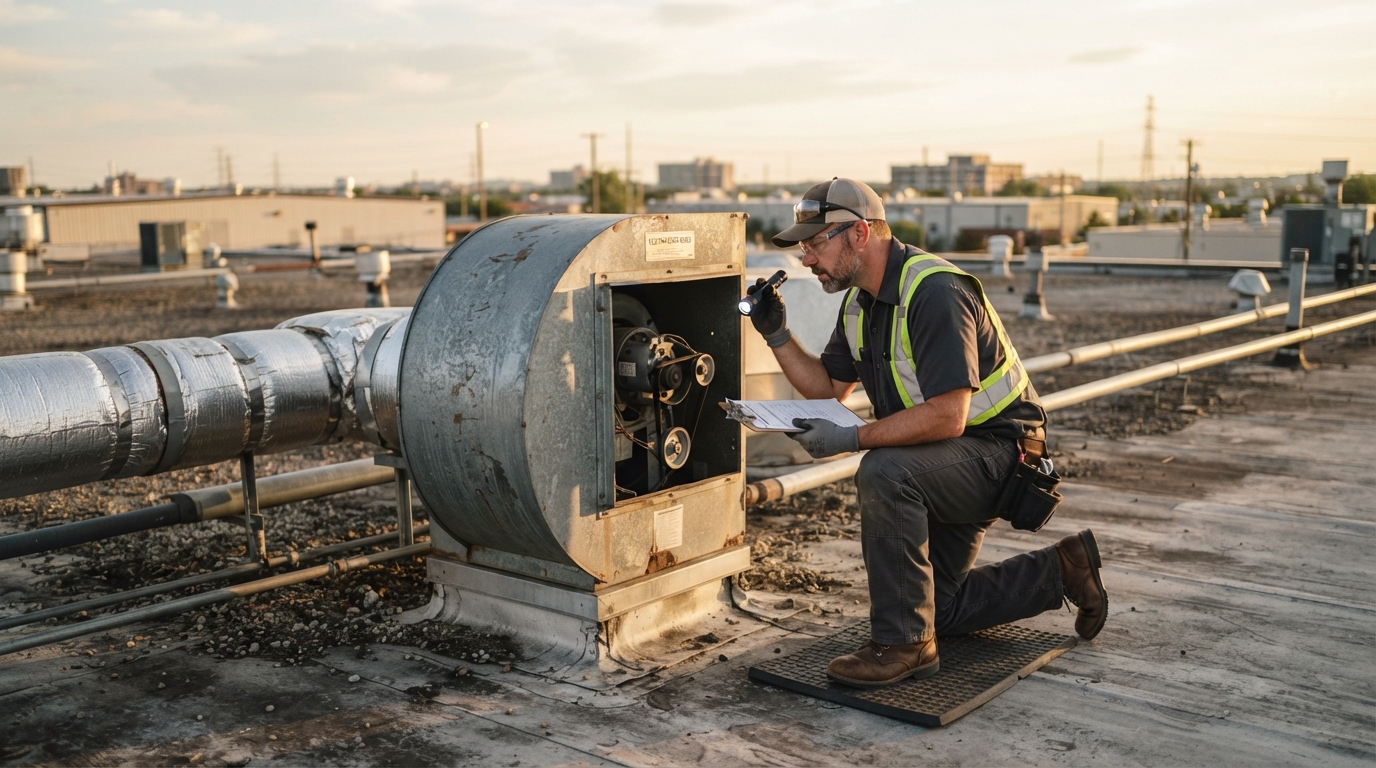
- Commercial ventilation equipment moves and exchanges air in warehouses, offices, and industrial buildings using fans, blowers, and ductwork sized for large volumes.
- Equipment choice depends on building size, occupancy, and contaminant load, with exhaust fans, roof ventilators, and inline blowers each serving different airflow needs.
- Ventilation rates in commercial spaces follow published engineering standards rather than guesswork.
Commercial ventilation equipment works by continuously exchanging stale indoor air for outdoor air using fans, blowers, and ducted pathways sized to a building’s volume and occupancy. In large spaces such as warehouses, manufacturing floors, and multi-story offices, this exchange prevents heat buildup, dilutes airborne contaminants, and supports the mechanical cooling or heating already in place.
Selecting Commercial Ventilation Equipment for a large facility typically starts with calculating square footage, ceiling height, and the number of people or processes generating heat and pollutants. Facilities managers then match that calculation to fan capacity, measured in cubic feet per minute, rather than selecting equipment by size or price alone.
How Airflow Moves Through Large Buildings
Large commercial spaces rely on a few core mechanical principles to keep air circulating.
- Supply and exhaust balance : Fresh air enters through supply fans or louvers while exhaust fans remove stale air, keeping pressure balanced.
- Dilution ventilation : Continuous air exchange lowers the concentration of dust, fumes, or heat rather than targeting a single source.
- Mechanical assistance : Rooftop units, inline duct fans, and centrifugal blowers push air through ductwork that natural airflow alone cannot reach in large volumes.
Ceiling height and floor area both affect how many air changes per hour a space needs, which is why equipment specified for a small office is rarely adequate for a warehouse or production floor.
Equipment Types Used in Commercial Settings
Several categories of equipment appear repeatedly in large-space ventilation systems, each suited to a different airflow role.
|
Equipment Type |
Primary Function |
Typical Setting |
|
Roof exhaust fans |
Remove hot or contaminated air upward |
Warehouses, kitchens, industrial plants |
|
Inline duct fans |
Boost airflow through long duct runs |
Multi-room offices, corridors |
|
Centrifugal blowers |
Move high volumes of air against resistance |
Manufacturing, dust collection systems |
|
Unit heaters |
Provide supplemental heat in open spaces |
Warehouses, workshops |
Matching equipment type to building layout matters because undersized fans strain motors and fail to clear contaminants, while oversized equipment wastes energy without improving air quality.
Standards That Guide Equipment Sizing
Ventilation equipment for commercial buildings is not sized by guesswork. The ASHRAE Standard 62.1 has served as the industry benchmark for commercial ventilation system design and indoor air quality since 1973, and it continues to guide how much outdoor air a space needs per occupant or per square foot. Office spaces generally need lower airflow rates per person than restaurants, gyms, or healthcare facilities, which generate more heat and airborne contaminants and therefore require higher exchange rates, according to Air Climate Control’s overview of commercial ventilation requirements. Local building codes and the International Mechanical Code often reference these same baseline figures.
Across the USA, facilities that fall under these commercial occupancy classifications are generally expected to document their ventilation rates during inspections or code reviews, which makes equipment selection a compliance matter as much as a comfort one.
Maintenance Considerations for Large-Scale Systems
Even correctly sized equipment underperforms without routine upkeep.
1. Inspect fan belts, bearings, and motors on a fixed schedule rather than only after failure.
2. Clean or replace filters to prevent airflow resistance that forces motors to work harder.
3. Check duct seals and dampers for leaks that reduce the volume of air actually reaching occupied areas.
4. Monitor for unusual noise or vibration, which often signals bearing wear before a full breakdown occurs.
Neglecting these steps can shorten equipment lifespan and reduce the airflow a system was originally designed to deliver.
Brooklyn Fan & Blower Sales Co is an industrial equipment supplier based in New York that lists commercial and residential fans, blowers, and air moving equipment among its listed offerings. Equipment of this kind is typically selected based on a facility’s square footage, occupancy, and ventilation code requirements rather than by brand preference alone.
Frequently Asked Questions
What is the difference between exhaust fans and inline duct fans? Exhaust fans pull air out of a space, often through a roof or wall opening, while inline duct fans boost airflow along an existing duct run to overcome distance or resistance.
How often should commercial ventilation equipment be inspected? Most facilities schedule fan and duct inspections at least annually, with more frequent checks for high-use kitchens, manufacturing floors, or healthcare settings where contaminant loads are higher.
Does ventilation equipment sizing differ across the USA? Sizing follows the same core engineering standards nationwide, though local building codes within the USA may adjust specific airflow requirements for certain occupancy types.
Can one ventilation system handle both heating and air exchange? Some unit heaters and rooftop systems combine heating with air movement, but dedicated exhaust and supply fans are still generally needed to meet minimum air exchange rates.
A current overview of listed equipment categories and service area details for Brooklyn Fan & Blower Sales Co is published for reference by facilities managers researching ventilation options.