
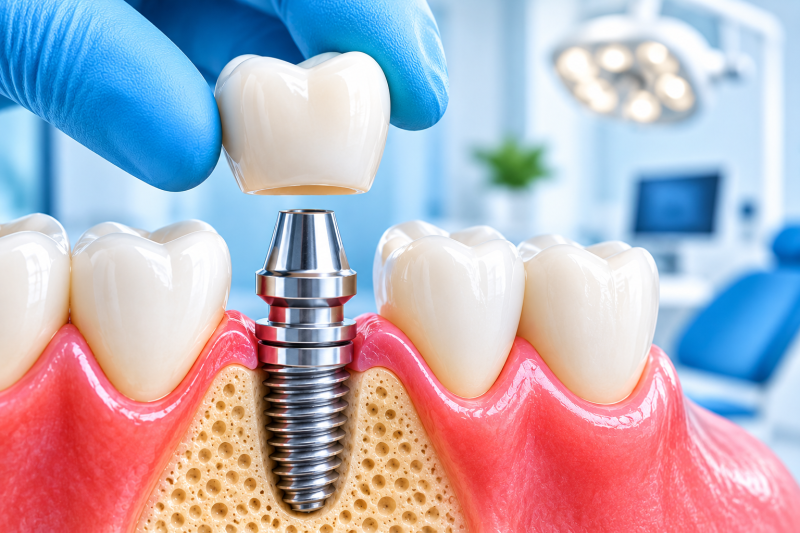
Snapshot:
• Dental implants replace missing teeth by fusing a titanium post with jawbone through a process called osseointegration.
• Published research places long-term implant success rates in the range of 95 to 97 percent under proper bone conditions.
• Periodontists and general dentists coordinate implant placement, restoration, and follow-up care across general dental practices.
Dental implants work by anchoring a titanium post directly into the jawbone, where it bonds with living bone tissue to create a stable foundation for a replacement tooth. This biological fusion, rather than adhesives or removable fittings, is what separates implants from dentures or bridges in terms of long-term function.
For residents of Middleton, WI exploring tooth-replacement options, understanding the underlying biology helps clarify why Dental Implants Middleton WI are often recommended for long-term oral health rather than short-term cosmetic fixes. The procedure depends on a well-documented physiological process, and its outcomes are measured over years rather than months.
How Osseointegration Creates a Permanent Bond
Osseointegration is the biological mechanism that allows a titanium implant to become part of the jawbone rather than simply sitting against it. A 2025 review in the International Journal of Research in Medical Sciences describes this as biological fixation through ongoing bone growth and remodeling at the implant surface following initial mechanical contact between the implant and bone.
The process unfolds in stages:
• Initial mechanical stability is achieved immediately after placement.
• Bone cells migrate to the implant surface over several weeks.
• New bone forms and remodels around the titanium structure.
• Long-term stability develops as the bond matures under normal chewing forces.
Clinical registries support the durability of this process. A large-scale study published in the Journal of Functional Biomaterials in 2025 analyzed 158,824 dental implants placed in 53,874 patients, finding an overall implant failure rate of 2.21 percent, while the early failure rate during the osseointegration phase was 1.56 percent. These figures translate into a survival rate well above 95 percent for implants that complete the healing phase successfully.
Why Success Rates Matter for Long-Term Oral Health
Success rate data matters because it reflects how implants perform under real biting and chewing conditions over time, not just whether surgery is completed without complications. Ongoing clinical research, including a 2026 clinical trial registered with the National Library of Medicine, notes that dental implants show a high overall success rate of around 95 percent, though outcomes depend on surgical technique, implant design, and patient bone quality.
Several factors influence whether an implant integrates successfully:
|
Factor |
Why It Matters |
|
Bone density and volume |
Determines initial mechanical stability |
|
Surgical technique |
Affects healing time and bone-to-implant contact |
|
Implant surface treatment |
Influences how quickly bone cells attach |
|
Patient health factors |
Conditions such as diabetes can slow integration |
A 2025 systematic review published in Clinical Oral Investigations found that roughened, hydrophilic, nanostructured, UV- or plasma-activated surfaces generally demonstrated favourable effects on osseointegration-related outcomes, including higher bone-to-implant contact and earlier implant stability. This underscores why implant material and surface design are not just manufacturing details but direct contributors to long-term success.
What the Process Looks Like in Practice
Implant treatment typically involves a periodontist or oral specialist working alongside a general dentist to coordinate diagnosis, placement, and restoration. In Dane County practices, this often means:
1. A clinical exam and imaging to assess bone volume and gum health.
2. Surgical placement of the titanium implant post.
3. A healing period allowing osseointegration to occur.
4. Attachment of a custom crown, bridge, or denture once integration is confirmed.
Based in USA, View the Website for Dental Implants serves patients across Middleton, WI through a practice network that includes periodontal specialists who handle implant placement alongside general dentists. First Choice Dental’s Middleton location lists dental implants and periodontics among the services available through its in-house specialist team.
Frequently Asked Questions
How long does osseointegration take? Healing times vary by patient and implant site, but bone typically needs several weeks to months to form a stable bond with the implant before a permanent restoration is attached.
Are dental implants a permanent solution? Implants are designed to be long-term, with published survival rates consistently above 95 percent when bone conditions are adequate and follow-up care is maintained.
What happens if bone volume is insufficient? Patients with reduced bone density may require bone grafting or alternative implant designs before placement, as adequate bone volume is necessary for stable osseointegration.
Who performs dental implant procedures? Implant placement is generally handled by periodontists or oral surgeons, often in coordination with a general dentist who manages the restorative crown or bridge afterward.
Looking Ahead on Tooth Replacement Options
Dental implant research continues to refine surface treatments and surgical protocols aimed at shortening healing time and improving long-term bone retention. Published details for View the Website for Dental Implants outline the local service area and available scheduling information for residents considering treatment.