Key takeaway:
• A broken garage door spring cannot be bent back into service; it requires full replacement by a trained technician.
• Torsion springs store enough force to lift a 150 to 400 pound door, making DIY repair a serious safety risk.
• Spotting the warning signs early, such as a loud bang or a door that will not budge, helps prevent further damage to cables, openers, and tracks.
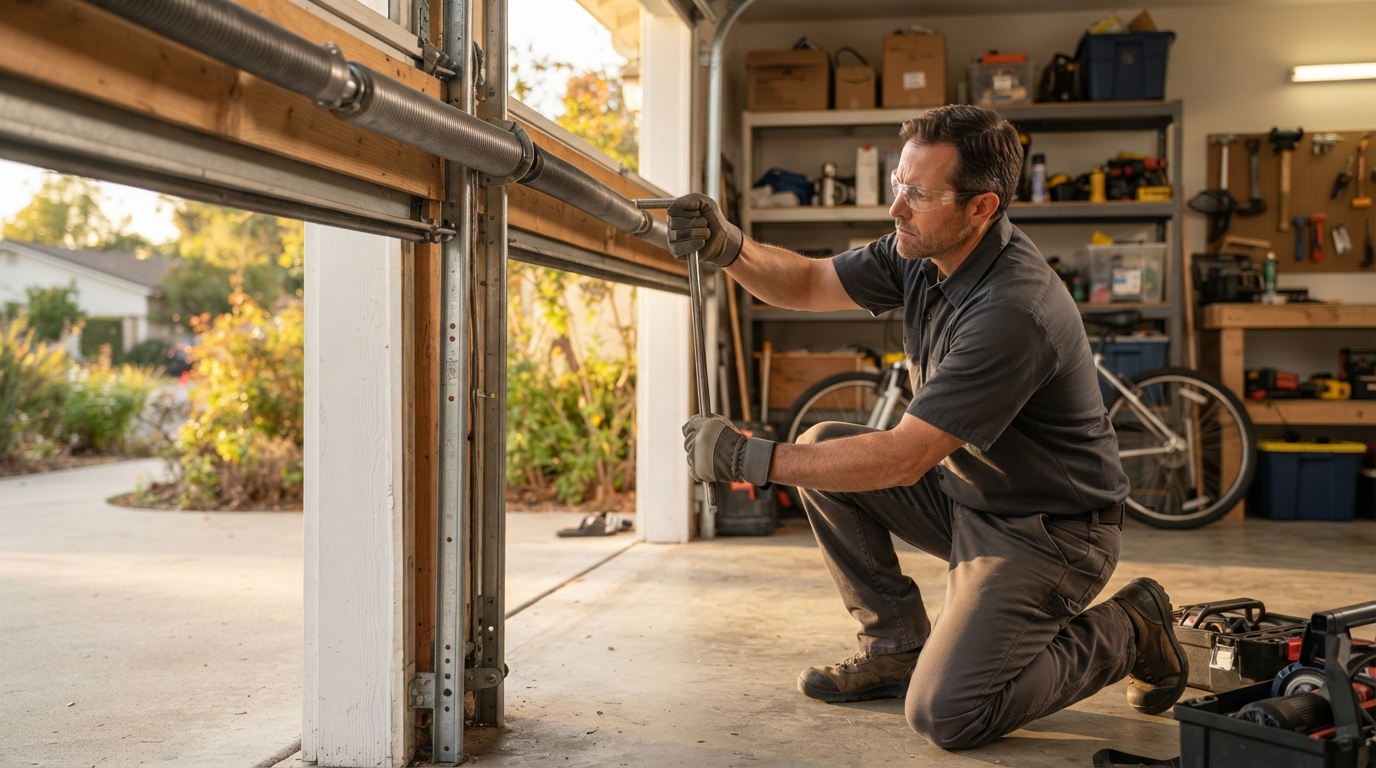
A door that suddenly feels too heavy to lift, or one that stops working after a loud bang from the garage, usually points to a broken torsion or extension spring. Professional Garage Door Spring Repair involves replacing the damaged spring with a correctly sized unit and resetting the door’s balance, not patching or rewinding the existing coil. Because this work involves components under extreme mechanical tension, it is one of the few garage door issues where calling a trained technician is the standard recommendation rather than a precaution.
Why a Broken Spring Is Not a Minor Fix
Garage door springs carry the full working weight of the door, and that stored energy does not disappear when a spring snaps. A fully wound torsion spring holds enough force to lift a 150 to 400 pound garage door, and that same tension can injure anyone who attempts to loosen or remove it without the right tools.
Industry guidance treats this as specialized work rather than routine maintenance.
• A garage door’s springs are arguably the most important and most dangerous part of the door, according to the Door & Access Systems Manufacturers Association.
• Extension springs that lack a safety cable can release suddenly when they fail, since a safety cable runs through the spring and secures to the wall or ceiling at each end while the door is under high tension.
• A broken torsion spring often shows as a visible gap in the coil, a door that sits unevenly, or a sharp bang audible from inside a home in Springfield, IL.
Spring Types and What Replacement Involves
Most garages built in the last few decades use torsion springs mounted on a metal bar above the door opening, though some older or lighter doors still rely on extension springs running along the horizontal tracks. The two types fail differently and require different replacement procedures, which is one reason pricing and timelines vary by job.
| Spring Type | Typical Location | Common Risk | Replacement Approach |
| Torsion | Metal shaft above the door | Stored rotational force during winding | Matched by wire size, length, and door weight |
| Extension | Along the horizontal tracks | Recoil if no safety cable is present | Paired springs replaced together with cables checked |
A technician typically inspects both springs even if only one has failed, since matched springs usually wear at a similar rate. Cables, pulleys, and the opener’s travel limits are often checked at the same time, since a failed spring can strain these connected parts.
What Happens During a Professional Service Call
A typical visit follows a predictable sequence, which helps homeowners know what to expect before a technician arrives.
1. The door is inspected while closed and the opener is disconnected to prevent accidental movement.
2. The broken spring is identified by type, size, and winding direction before a replacement is sourced.
3. The old spring is removed using specialized winding bars rather than household tools.
4. The new spring is installed, wound to the correct tension, and tested through several open-close cycles.
5. Cables, rollers, and weatherstripping are checked for related wear before the job is closed out.
Homeowners in Springfield, IL dealing with a door that will not open should avoid forcing the opener, since the opener is not built to lift that much weight on its own and depends on the spring to share the load. Leaving the door closed and the opener unplugged until a technician arrives limits further strain on the track and panels.
Frequently Asked Questions
Can a broken garage door spring be repaired instead of replaced? No. Once a spring snaps or loses its coil tension, it cannot be rewound or patched; the standard practice is full replacement with a correctly matched spring.
How long does a spring typically last before it needs replacement? The industry standard lifespan for a garage door spring is approximately 10,000 cycles, where one cycle equals one full open-and-close sequence, though usage patterns affect the actual timeline.
Is it safe to open the door manually with a broken spring? Manual lifting puts the full weight of the door on a person rather than the spring system, so it should only be attempted briefly and carefully, with the opener disconnected first.
Should both springs be replaced if only one breaks? Many technicians recommend replacing both springs together on doors with a pair, since they typically wear down close to the same time and mismatched tension can cause uneven operation.
Service Area and Next Steps
Based in Decatur, IL, the company serves customers across Springfield, IL.
Current scheduling information for Click Here For Garage Door Spring Repair is published for homeowners weighing a spring replacement.