
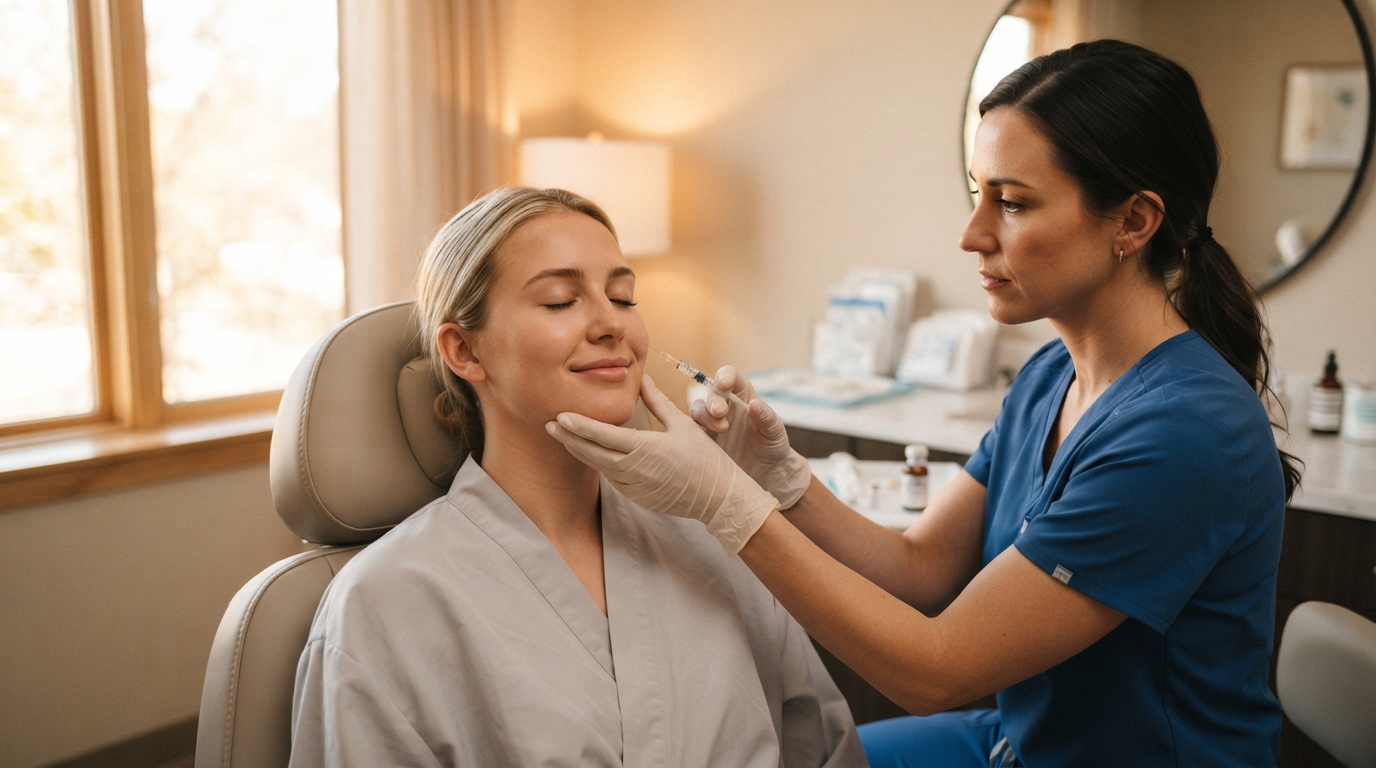
• A qualified Sculptra specialist should hold a verifiable medical or nursing license and documented injectable training.
• Sculptra results depend on correct dilution, injection depth, and post-treatment massage technique, not just the product itself.
• Ask about candidate evaluation, treatment planning, and vial dosing before booking.
Choosing a Sculptra specialist means looking past marketing and checking for clinical credentials, injection experience with collagen biostimulators specifically, and a clear process for evaluating facial structure before treatment. Because Sculptra works differently than traditional dermal fillers, technique and aftercare guidance matter as much as the product itself.
Sculptra, injectable poly-L-lactic acid, is a biostimulator rather than an immediate-volume filler. Poly-L-lactic acid is a biocompatible, biodegradable synthetic substance considered a semi-permanent filler because results typically last more than two years while also helping stimulate collagen production. It addresses the root cause of aging skin by activating new collagen production once injected into the dermis. That mechanism is why provider skill in dilution, placement, and massage protocol directly affects outcomes.
Credentials and Clinical Training to Verify
A provider’s license type and injectable-specific training are the starting point for any evaluation.
• Confirm the practitioner is a licensed medical professional, such as a nurse practitioner, physician assistant, or physician, rather than an unlicensed aesthetician.
• Ask whether training included hands-on instruction specifically for poly-L-lactic acid products, since dilution ratios and injection depth differ from hyaluronic acid fillers.
• Look for willingness to discuss contraindications; FDA labeling contraindicates use in patients with allergies to any component or a history of keloid formation.
Evaluation and Treatment Planning Process
A qualified specialist should walk through facial assessment before recommending a vial count or injection pattern. According to the FDA’s approved product information referenced by Galderma, Sculptra is indicated for correction of shallow to deep nasolabial fold contour deficiencies, fine lines and wrinkles in the cheek region, and other facial wrinkles, which means treatment planning should map to those approved indications rather than generalized volume promises.
• A thorough consultation should assess skin laxity, collagen loss, and treatment goals before any injection occurs.
• Vial dosing should be explained in relation to the treatment area, since under- or over-correction both carry downsides.
• A specialist should be transparent about the gradual timeline, since results build over multiple sessions rather than appearing instantly.
|
Factor |
What to Ask |
Why It Matters |
|
Licensing |
Is the injector a licensed medical provider |
Confirms legal and clinical accountability |
|
Technique training |
Experience specific to PLLA dilution and injection depth |
Affects smoothness of results and nodule risk |
|
Aftercare guidance |
Massage protocol and follow-up schedule |
Impacts how evenly collagen stimulation distributes |
|
Treatment planning |
Number of vials and sessions recommended |
Prevents under-treatment or overcorrection |
Aftercare Guidance That Signals Experience
Post-treatment instructions are a practical marker of a provider’s familiarity with how Sculptra behaves after injection. Massaging the treated area helps evenly distribute Sculptra, following a rule of thumb known as 5-5-5: massaging the injected area for five minutes, five times a day, for five days in a row. A specialist who proactively explains this schedule, rather than leaving it to a printed handout, is demonstrating practical experience with the product’s biological mechanism.
For patients in Miami Beach, FL, humidity and sun exposure during recovery weeks can influence swelling and skin sensitivity, so a provider familiar with local conditions may offer more specific aftercare timing. Reviewing how a specialist handles these variables, alongside their licensing and planning process, gives a clearer picture of qualification than price or marketing claims alone.
Frequently Asked Questions
Is Sculptra the same as a dermal filler? No. Fillers using hyaluronic acid provide immediate volume by attracting volume where the filler is injected, while fillers with poly-L-lactic acid like Sculptra stimulate the body’s ability to produce collagen over time, giving more gradual and longer-lasting effects.
How long do Sculptra results last? Sculptra is FDA-approved for cheek wrinkles and nasolabial folds, with effects lasting up to 24 to 36 months according to the FDA summary of safety and effectiveness data.
Does Sculptra require allergy testing before treatment? Since Sculptra does not contain any human or animal components, no allergy testing is needed prior to treatment.
What should happen during the first consultation? A qualified provider should assess facial structure, discuss realistic timelines, and explain vial dosing before recommending a treatment plan, rather than moving directly to injection.
Based in USA, VIIV WELLNESS HAUS serves patients across Miami Beach, FL, offering medical spa and injectable consultations within that service area.
Current scheduling and consultation information for VIIV WELLNESS HAUS is published for reference by patients researching collagen-stimulating treatments.