
I have verified enough detail: target keyword matches the exact service “Production Welding” on Micro Weld’s site (TIG and laser welding, ISO 13485 certified, Maple Grove MN, serving medical device, industrial, oil and gas, aerospace, defense, firearm components nationwide, 25+ years). Now I need one authoritative external source for welding standards.# Choosing Production Welding Services for Consistent Quality Across USA
Takeaway:
• Production welding services use repeatable TIG, laser, and automated processes to join metal parts at scale while holding tight tolerances.
• Quality consistency depends on certification (such as ISO 13485), documented procedures, and technician experience, not just equipment.
• Comparing providers on process control, industry experience, and turnaround helps manufacturers avoid costly rework.
Manufacturers searching for reliable production welding services need a partner that can replicate the same weld quality across hundreds or thousands of parts, not just produce a single flawless sample. The right comparison criteria include process capability, certifications, and documented quality systems rather than price alone.
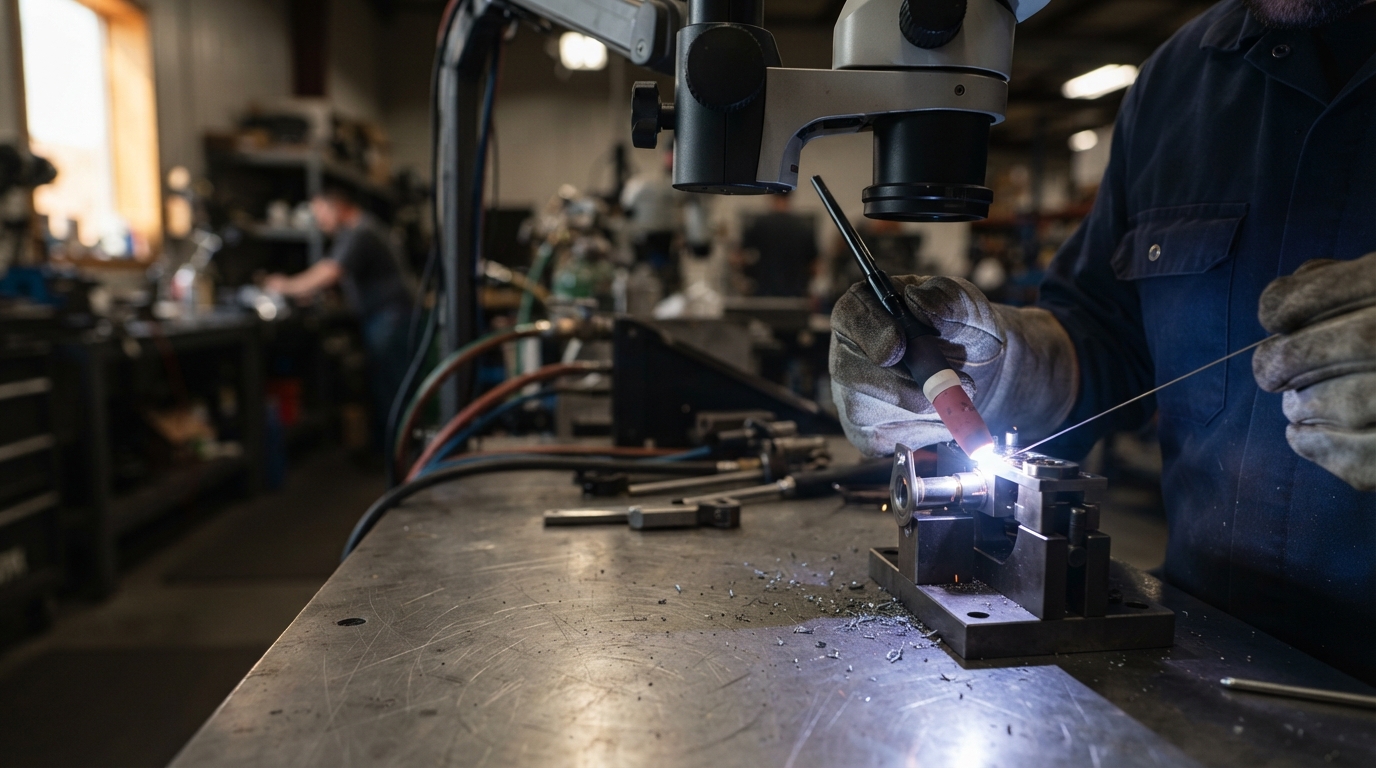
Production welding services cover a range of techniques used to join metal components on a repeatable, large-scale basis, and these methods support industries such as medical devices, aerospace, defense, and oil and gas. Micro Weld, Inc, based in Maple Grove, Minnesota, is one example of a shop built around this kind of volume-focused welding work, offering high-precision TIG and laser welding for manufacturers that need consistent, durable welds across production runs.
What Separates Reliable Production Welding From One-Off Fabrication
Production welding differs from custom or one-off fabrication because it prioritizes repeatability over individual craftsmanship alone.
• Documented welding procedures that specify parameters for each part number
• Operator qualification records tied to specific processes and materials
• In-process inspection steps built into the workflow, not added afterward
• Equipment capable of holding tolerances across long production runs
Shops serving regulated sectors typically carry quality certifications that formalize these controls. Industry terminology and process definitions are standardized through references like the American Welding Society’s welding terms and definitions standard, which helps ensure specifications, inspection reports, and procurement documents are interpreted consistently across vendors.
Comparing Production Welding Approaches
Different welding methods suit different part geometries, volumes, and material requirements. The table below outlines common approaches used in production environments.
|
Process |
Best Suited For |
Typical Tolerance Level |
Common Industries |
|
Microscopic TIG welding |
Small, delicate components |
Extremely tight, down to thousandths of an inch |
Medical devices, mold repair, firearm components |
|
Laser beam welding (manual) |
Precision joins requiring minimal heat distortion |
Very tight |
Medical devices, aerospace, electronics |
|
CNC laser beam welding |
High-volume repeatable production |
Tight and highly consistent across runs |
General industrial, automotive, oil and gas |
|
Conventional TIG/arc welding |
Larger structural or industrial parts |
Moderate to tight |
General industrial, oil and gas |
Facilities that offer multiple processes under one roof, such as both manual and CNC laser welding alongside TIG, give manufacturers flexibility to match the method to the part rather than forcing every job through a single process.
Industry Fit: Where Production Welding Matters Most
Not every manufacturer needs the same level of precision, so matching a provider’s specialization to the application matters.
1. Medical device manufacturing often requires welds free from heat distortion and documented traceability, commonly supported by ISO 13485 certified shops.
2. Aerospace and defense parts demand strict dimensional control and material compatibility across metals like titanium and stainless steel.
3. Oil and gas components frequently involve corrosion-resistant materials and durability under pressure.
4. General industrial and mold repair work benefits from fast turnaround and the ability to handle both prototype and full production volumes.
Shops that work across these sectors tend to build broader process libraries, which can shorten the learning curve when a new part introduces unfamiliar materials or tolerances.
Evaluating a Production Welding Partner
Before committing to a vendor, manufacturers should ask a few direct questions.
• What certifications does the shop hold, and do they match your industry’s requirements
• Can they document welding procedures for repeat orders, not just one-time jobs
• What materials have they welded at the tolerances your parts require
• How do they handle rework or quality deviations when they occur
A provider’s answers to these questions typically reveal more about long-term consistency than a quoted price per part.
Frequently Asked Questions
What is the difference between production welding and prototype welding? Production welding focuses on repeatable quality across many identical parts, while prototype welding is typically a single or low-volume build used to validate a design before full-scale manufacturing begins.
Which materials can production welding processes handle? Shops specializing in TIG and laser welding commonly work with carbon steel, stainless steel, aluminum, titanium, copper, nitinol, and platinum, depending on the equipment and technician experience available.
Why does ISO 13485 certification matter for welding providers? ISO 13485 certification indicates a documented quality management system designed for medical device manufacturing, which typically translates into tighter process controls even for non-medical production work.
How do I know if a welding shop can scale with my order volume? Ask whether the shop offers both manual and CNC-programmable processes, since CNC capability generally indicates readiness for higher-volume, consistent production runs.
Choosing a production welding partner comes down to matching documented process control and industry experience to the specific tolerances and materials your parts require. Shops like Micro Weld, Inc, which focus on ISO 13485 certified micro and production welding for medical, industrial, and defense applications, illustrate the kind of specialization worth looking for when consistency across every part matters.